


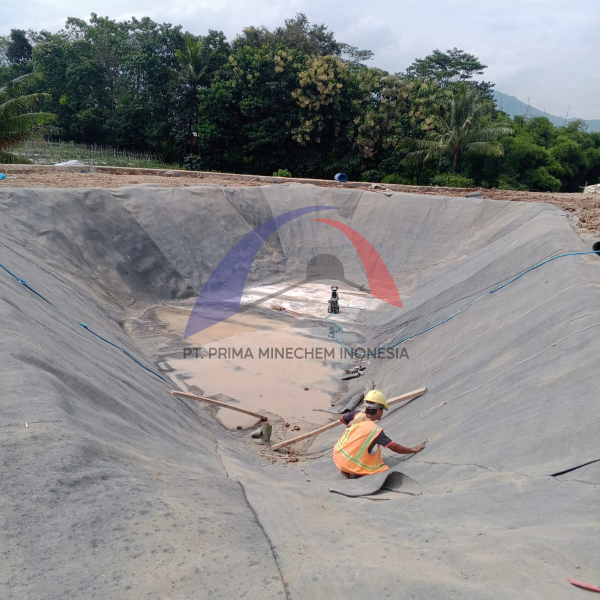
Case Study Information
Project Type: Pond Lining
Project Type (other): Industrial Factory
Project Start Date: March 2025
Project Objective:
The primary objective of this project is to waterproof a clean water reservoir pond in a shoe factory area with a shorter construction time.
Project Location: Garut Regency, West Java.
Number of Installers: 6
Amount of Concrete Canvas Used: 475 m²
Roll Format: Bulk Roll
Type/Thickness: CCX-M
Layup Method: Transverse and Longitudinal
Installation Process
Equipment used
- Webbing Sling 3 meters x 2 tons
- Excavator
- Cutter/utility knife
- Hammer
- J-Pin 25 cm
- Polyurethane Sealant
- 30 mm stainless steel screws
Alternatives and Reasons for Choosing Concrete Canvas
Previously, contractors used crushed stone to line clean water reservoirs. However, this method required a significant amount of time, taking up to a month to complete one pond. Considering time efficiency and project implementation, Concrete Canvas was implemented as an alternative to the stone masonry for the pond lining at the shoe factory.
Environmental Conditions
The project was carried out on an excavated site in a shoe factory, which was still under construction. Installation took place in dry weather conditions, with no rainfall recorded during the process. No extreme environmental conditions were encountered during the installation.
Land Preparation
- Vegetation clearing
- Pond profile formation
- Pond floor construction
- Pond bottom excavation
- Pond trench excavation
Installation, Bonding, and Sealing Methods
The CCX-M Concrete Canvas was installed transversely and lengthwise, covering the entire pool. The Concrete Canvas was mobilized with two excavators, to hold the Concrete Canvas roll, and to pull the roll from the other side of the pool. After being rolled out, the Concrete Canvas was adjusted to the pool profile. At each overlap of the Concrete Canvas, a 25cm J-pin was installed in the anchor trench at the shoulder of the pool, and also installed every 3m. The connection between the segments was carried out using a combined method of screws and sealant. Polyurethane sealant was applied to the part of the concrete canvas that would be overlapped, with a diameter of 8mm extending to fit the profile of the pool. Then, the Concrete Canvas was overlapped and screws were installed at the top of the concrete canvas overlap. The screws used were stainless steel screws with a length of 30mm, with a distance of 10cm between the screws installed at each overlap.
Hydration Method
The hydration process is carried out using a hose connected to a water pump, with the water source coming from the nearest water channel around the project site.
Installation Duration
This project was completed in 3 days, with installation productivity reaching approximately 158 m² of Concrete Canvas per day.
Project Success
The project was deemed a success. The client was satisfied with the speed and ease of Concrete Canvas installation and plans to reorder it if they undertake similar projects.
Measurable Success Indicators
The speed of work compared to applications usually carried out by contractors, namely stone masonry.

“We were very pleased with the use of Concrete Canvas on this project. Installation was quick and efficient—much faster than using traditional masonry construction. If we have future pool projects, we would recommend CC again, not only for this location but also for other projects within our company.”
— [Project Manager]
