



Case Study Information
Project Type: Channel Lining
Project Type (Other): Government
Project Start Date: September 20, 2025
Project Objective:
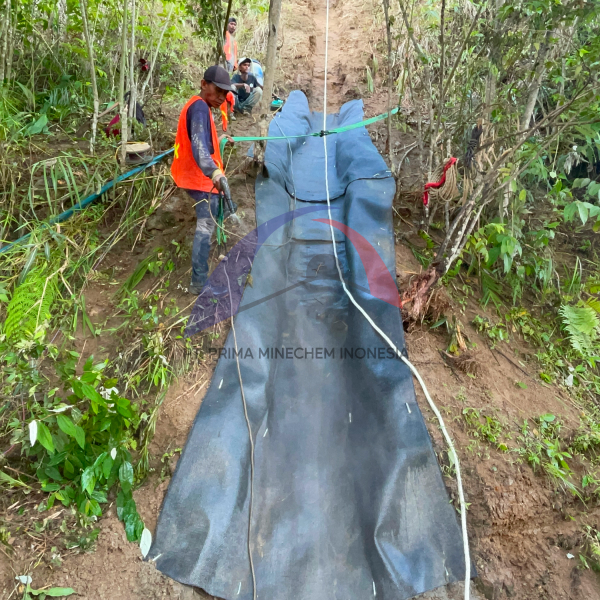
The primary objective of this project is to control rainwater flow over hillsides to prevent it from flowing directly onto slopes prone to landslides. This channel allows water flow to be safely directed and controlled to prevent erosion of the slope's soil. The use of concrete canvas is expected to reduce the risk of landslides that could endanger the roadway below the slope, especially during heavy rainfall.
Project Location: Palu, Central Sulawesi
Number of Installers: 12
Amount of Concrete Canvas Used: 950 m²
Roll Format: Bulk Roll
Type/Thickness: CCX-M
Layup Method: Transverse
Dimensions : 2.5 meters per segment
Installation Process
Equipment used
- Excavator
- Pulley + Belt
- Cutter/utility knife
- J-Pin 40 cm
- 30 mm stainless steel screws
Alternatives and Reasons for Choosing Concrete Canvas
Previously, water flow control was achieved using earthen channels, but this method was deemed ineffective due to their susceptibility to landslides and rapid sedimentation. Alternatives such as stone masonry channels were also less feasible, given the extremely difficult terrain and elevation of approximately 40 meters. Therefore, the use of concrete canvas was chosen as a more appropriate solution due to its practical installation, stability, and optimal performance in steep and difficult-to-access terrain.
Environmental Conditions
The project's environment is located in a hilly area in Palu City, Central Sulawesi Province. The channel is located on a hilltop beside the main road, approximately 40 meters above the road surface. This makes water flow control a critical requirement for maintaining slope stability and road user safety.
Land Preparation
- Channel Reshaping
- Creating anchor excavations
Installation, Bonding, and Sealing Methods
The concrete canvas is installed transversely in the direction of the water flow. Each sheet of concrete canvas is connected with a 10 cm overlap and secured using 3 cm stainless steel screws. To ensure the material doesn't shift, 40 cm JPEG anchors are installed at each joint. These anchors are embedded within the anchor holes to ensure the concrete canvas is securely secured and remains stable, especially on steep slopes.
Hydration Method
The concrete canvas hydration process uses water transported in a water tank. The water is then channeled through a hose to the top of the slope, ensuring the entire surface of the concrete canvas is evenly hydrated. This process ensures the material can harden completely and achieve the desired strength.
Installation Duration
Installation productivity is approximately 285–380 m² of Concrete Canvas per day.
Project Success
The project was deemed highly successful, as evidenced by customer satisfaction with the work. The concrete canvas pipeline performed as planned, leading the customer to express a desire to repeat the order for similar work at other locations.
